Skip to content

Posts tagged ‘spain’

Granada | What else to do in Granada

It’s been a long, wet winter, but at last Spring seems to be just around the corner. This is the best time to come to the south of Spain, and to one of its most popular destinations, the city of Granada at the foot of the Sierra Nevada.

You will of course be paying a visit to the Alhambra, the magnificent palace fortress of the Moorish kings, and to the Generalife (top tip – have a drink on the terrace of the Parador hotel looking across to the Generalife), but what are you going to do for the rest of your stay?

albaicin markets

First option is to make your way up through the Moroccan market into the Albaicin, the old Arab quarter of the city with its picturesque steep, narrow streets to the San Nicholas Mirador for a view across the valley of the River Darro to the Alhambra and the snowy peaks of the Sierra Nevada beyond. It’s also worth walking up the river valley from Plaza Nueva, the classic Spanish square in the heart of the city. It still looks like the mountain stream it was, but now with houses perched on its high banks below the steep hill of the Alhambra. Going further brings you into the Sacramonte neighbourhood, famous for its gypsy community, cave houses and flamenco night-life (nowadays mostly for tourists, but still an unmissable experience).

On the other side of the Alhambra is the old Jewish quarter of the Realejo, now a busy neighbourhood of bars and restaurants. Between the Realejo and the Alhambra you can find the Carmen de los Martires, one of Granada’s less well known gems. Carmenes (houses with walled gardens) are typical of Granada, and there are quite a few of them, often now functioning as hotels and restaurants rather than private houses, but Los Martires is the grandest, with several acres of gardens laid out around a 19th century country house.

carmen terraceview from our Carmen Terrace 2 apartment in Granada

At the foot of the Realejo, as you get back to the centre is the Corral del Carbón, originally built as a coal warehouse way back in the Moorish period, but adapted in the 16th century for theatrical performances (these courtyard theatres are roughly contemporary with Shakespeare and the birthplace of Spanish theatre). Pay your respects at the Royal Chapel and Cathedral, then take a walk along the Alcaicería, once the Moorish silk market, but now mainly little souvenir and artesan shops, but still with a Morroccan feel to it.

Behind the Cathedral is the Plaza Bib-Rambla, Granada’s largest public square, and an important commercial space since mediaeval times, and also the location of bullfights and autos-da-fé. Nowadays it has many cafés and restaurants in the colonnades around it, and in the centre is the Fountain of the Giants, added in the 19th century. From here, take a walk up through the Bib-Rambla neighbourhood to the San Jeronimo monastery. Built in the period following the Reconquista, it’s a calm and peaceful oasis with its two cloisters full of orange trees and magnificent altarpiece. It’s also the burial place of El Gran Capitán, Gonzalo Fernández de Córdoba, who led the Spanish forces that conquered Granada.

Finally, for something completely different, pay a visit to Granada’s famous science park. The interactive displays and exhibits are child-friendly and great fun as well as fascinating, dealing with everything from the birth of the universe to the diversity of life.

For more information about Granada, and some great holiday apartment rentals visit our website.

Seville | Long Term Apartment Rentals

The short term/holiday rental apartment market is naturally geared to couples, families or groups of friends who are staying in the same place for a few days to a week, and who prefer the comfort, convenience and freedom of an apartment compared to a hotel room, so there’s no shortage of good quality apartments available in a wide range of sizes and prices to cater for most budgets.

But what do you do if you are away on business or a temporary job or assignment that means you need to stay in the same place for a longer period, or if you’re a traveller who wants to take the time to really get to know more about the life and culture of a city in a way that you can’t in just a few days? Typical rates for hotels or short term rentals are likely to work out seriously expensive if you’re staying for a month or three, but fortunately there is a solution.

san luis long term rentalSeville Long Term Apartment San Luis

If you know where to look there are longer-term rentals available at reduced rates, usually by the month. Veoapartment now has a number of apartments in Seville available at reduced monthly rentals. Tailor-made for this market, these are studio and 1-bedroom apartments for up to 2 people that come with everything you need to do all your own cooking and laundry, as well as having TV and internet access. We can also arrange a cleaning service for you.

 So if you’re looking for somewhere comfortable and affordable to stay for a month or more, get in touch. We’ll help you find what you’re looking for.

Recipe | Fabada Asturiana

This is another of those traditional Spanish bean stews that are so perfect for keeping you warm on a winter’s day. This one originated in the northern province of Asturias, but is now naturalised throughout Spain and also southern France. The basic ingredient is the large white beans known in Spain as fabes, cooked with pork belly, morcilla (blood sausage) and chorizo, which you can also find pre-packaged as “preparado de fabada” in most supermarkets.

fabada

The result is a really tasty and filling dish that works well as a snack, starter, or main meal.

  • 1 kilo alubias blancas (large white beans)
  • 100 grams each: tocina, chorizo and morcilla
  • 200 grams chopped bacon (optional)
  • 2 tsp pimentón piquante (hot smoked paprika)
  • 1 tbsp black peppercorns
  • salt to taste (I used about 3-4 tsp)
  • 6 cloves garlic (peeled and chopped)
  • 1 medium onion (diced)

Soak the beans in cold water overnight, then rinse well and place in large stewing pot. Cover with cold water (about an inch or so over), add the tocina, chorizo and morcilla. Add salt, peppercorns and paprika, mix well, then bring to a boil. As soon as the water boils, lower heat to a simmer and then start skimming off the sludge that rises to the top. Stir very occasionally, just enough so it doesn’t stick, otherwise the beans will break up. Add more water if required. Cooking time may vary, somewhere between 1-1.5 hours, until the beans are cooked through but still firm.

While the beans are cooking, sautée the onion and garlic until translucent, then add the bacon (if desired) and continue cooking until everything is nicely browned. When the beans are almost done remove the tocina, chorizo and tocina, cut them into small slices and return them to the pot. Then add the cooked onions, garlic and bacon. Give it a quick stir, add a bit more water if you need it, and simmer another 10 minutes.

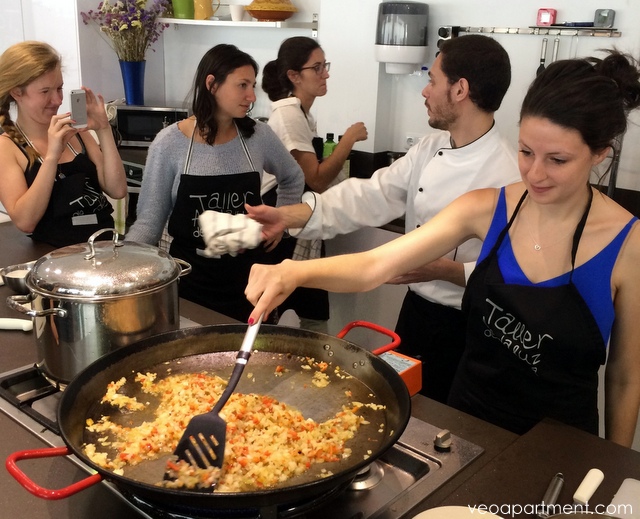
If you’d like to learn how to make Fabada Asturiana or any other typical Spanish dish then we recommend Travel & Cuisine who will create a custom made cooking experience for you.

And if you are more interested in learning how to shop for yourself like a local so you can make your own fabulous meals in your holiday apartment, check out Azahar Sevilla’s Market & Tapas Tour.

Miradores of Seville

This week’s post is by guest blogger Peter Tatford,
former Londoner and long-term Seville resident, aka Seville Concierge

Okay, it’s true that Seville doesn’t have miradores (lookout points) in the sense that Granada has them, up on the hillside facing the Alhambra, but if you want a bird’s eye view of the city, and most of us do, there are several vantage points you can head for that take you up and out of the maze of narrow streets.

The first, and it has to be admitted, most obvious, is the Giralda tower, alongside the Cathedral in the Plaza Virgen de los Reyes. Built in the 12th century as the minaret of the Moorish Grand Mosque, it’s original purpose was not for vision, but for sound – allowing the voice of the muezzin to carry across the city unobstructed by taller buildings. This is also the reason why the top of the tower is reached by means of a ramp, rather than stairs; climbing the tower five times a day in Seville’s summer heat was too demanding, and the ramp allowed the muezzin to ride up on his donkey. From the top you can see a fabulous roofscape of the Barrio Santa Cruz (it’s a whole other world up there, invisible from ground level), and of the Alcázar Palace and gardens.

View from the Metropol Parasol, Seville

Stop number two is the Espacio Metropol Parasol, the futuristic mushroom-shaped structure in the Plaza de la Encarnación. Completed just two years ago, it features not only the rooftop bar and walkway, but also the Antiquarium Museum, and one of the city’s principal provisions markets. Great views of the Macarena and San Vicente, and towards the river and la Cartuja.

Moving on to stop number three we arrive at the Torre de Los Perdigones, near the Macarena end of the Barqueta Bridge (the one that looks like a strange musical instrument). The original purpose of the tower was the making of lead shot, but it’s now been converted to house a camera oscura and an external viewing platform that’s a bit of a challenge for anyone with vertigo. Worth the trip, though, for the unusual views of the Expo ’92 site, the Alameda, and the old walls.

Finally, although not as tall, the Torre del Oro offers not only an excellent vantage point overlooking Triana and the river  (its original function), but also an unusually clear view of the upper parts of the front of the Cathedral.

If you’re more adventurous, or just have more time, you could head out across the river to the Aljarafe, specifically to Camas, where you can look right across the valley from the hilltops, a view that visitors don’t often get to see.

In addition there are a number of rooftop bars that give good views of the city (personal favourites are at the Fontecruz and the Hotel Inglaterra), so take advantage of the one at your hotel, or the terrace of your apartment.

Seville will shortly acquire a new lookout at the top of the Torre Cajasol. This will have the double advantage of being the highest in Seville, and also the only one which doesn’t have the tower itself as a feature of the view. Enjoy!

Seville | Christmas Markets

In Seville this December? Planning on some fun Christmas shopping? Seville hosts a number of street markets during the festive season which add some variety and colour to the normal high street shops and department stores, and are worth a browse around to see if you can pick up a bargain or something unusual.

The christmas book fair is still on in Plaza Nueva until Sunday (December 9), with an interesting variety of old and specialist books (mostly in Spanish, of course).  This is followed on the same site from December 14 by the annual Christmas Artesan Market, featuring handcrafted  games, gifts, clothes and accessories in wood, leather and ceramic. Of all the markets, this is the best one to head for if you’re looking for something a bit more classy than the usual market fare.

 
The Fería de Belen (nativity), where you can go to buy everything you need for your nativity scene, is in Calle Fray Ceferino González, between the cathedral and the Archivos de India. Stables, mangers, sheep, wise men, Roman centurions – you name it, they’ll have it. Browsing or buying, if you’re into either christmas or models spend a while wandering around here.

There are traditional Christmas fairs in Alameda de Hercules and Plaza de la Encarnación. The stalls are mainly artesan jewellery and leather goods, but include a traditional bread stall and some fast food and funfair style sweet stalls. For the children there are fairground rides, a visit to the tent of the Three Kings (the Spanish alternative to Father Christmas who brings them their presents on January 6) under the Metropol Parasols, “Christmas tree cones”, and a miniature train to take you from one site to the other. The highlight of a visit has to be the camel rides in the Alameda, which give you a rare chance to get close to these unusual animals.

For the first time there is a Christmas market this year alongside the Puerta Jerez and the Christina, featuring craft, jewellery and leather goods and attendant takeaway food stalls.

From December 6 to 8 only (10am to 7pm) there is an exhibition and sale of the traditional sweets, cakes and pastries made in the closed convents in and around Seville in the Gothic Palace of the Alcázar (entrance through the Patio de Banderas). Plenty to tempt anyone with a sweet tooth.